Prelude
About a year ago Forrest Rowland asked if I wanted to go to NE India on his birding trip. After consulting with my girls I consented. On the first and second of April I journeyed to Guwahati. I left Heathrow at 10:30 AM. It was an eight hour flight to Delhi. We got there a little after 11:00 PM. Then it was an incredible six hour layover until 6:20 AM till our flight left for Guwahati. It’s not the only flight in Delhi with a long layover. There are so many that there are actually lounge chairs where people can lay down and rest. (All were taken, darn.) But there was some joy in the airport. I found a Papa Rotti. It’s a Malaysian chain I first came across in Las Vegas last summer. They have these rolls that are beyond description they are so good.
Blue-throated Barbet, An ATM and an E-sim Chase
April 2, 2026
Once I got to Guwahati I was looking and looking for someone to take me to the hotel. A guy came up to me and asked if I was a birder. It was Ted another one of the people on the NE India Rockjumper trip. Eventually two drivers found us and took us the short distance to the hotel. What was striking was how birdy it was even around the hotel in a pretty urban area. My first Indian bird was the gorgeous blue-throated barbet. There were two of them in the tree I have a wonderful view of from my hotel window.
I decided I had two goals for the 2nd. Find an ATM and find a e-sim for my phone. At the Delhi airport a helpful woman recommended Saily for to get an e-sim. I downloaded the Saily app and an Indian e-sim but it seemed really flimsy and wasn’t working properly. I found an ATM in Guwahati and took out what I think will be enough rupees for the trip. Then I decided it was time to go looking for an e-sim. A driver offered to give me a ride. He spoke virtually no English but he was very friendly so I decided what the heck. What happened next was absolutely classic. We drove all over looking for a sim. We talked to a friend of his that spoke some English and we used ChatGPT to communicate back and forth. Meanwhile I was compiling a decent list of birds as we plied the highways and byways of Guwahati. Eventually we got to a store where a guy went through all of the paperwork to get me a sim. Unfortunately he got me a physical sim. He tried to convert it to an e-sim but it never worked. I resigned myself to nothing but spotty hotel wifi during this trip. Eventually my new found friend dropped me back at my hotel. As I worked through a mountain of wonderful Indian food at the hotel’s restaurant I used Saily’s help ai to see if I could diagnose the problem. And eventually I found the screen with a data roaming button. I turned that on and voila’ I had internet service on my phone. Ted came to the restaurant later and we had a great time talking birds and birding over dinner.
21 species, 17 lifers.
Birds, Birds, Birds and Prasanna
April 3, 2026
This morning I was wide awake at 4:00. I was excited because I was going birding. Prior to coming to Guwahati I contacted the hotel wondering if they knew any bird guides. They put me onto Peter Lobo who coordinates the Rockjumper tours for NE India and Peter put me onto Prasanna Bonyabondhu a local guide. I reached out to him and we agreed to meet at the hotel at 6:00 this morning. Peter also told me Bukey the Rockjumper guide for Mishmi Hills and Eaglenest would be joining us. Wow, two guides, one birder, what a deal. I was already outside the hotel birding when they pulled up. I had 12 species while I waited for them. We had a birding extravaganza today. We started in the Garbhanga Reserve Forest. The birding there was incredible. Some of the many highlights included three kinds of green pigeons, dollarbird, tiny and gorgeous speckled piculet and white-browed piculet, (Prasanna worked really hard to get me on the white-browed piculet.), gray-capped pygmy woodpecker, three scarce great slaty woodpeckers flying over, pale-chinned flycatchers, gorgeous yellow-bellied warbler, Asian fairy-bluebird…the list goes on and on. It was truly amazing. By the time we left the forest we had 66 species.
Lunch was Indian food, (surprise, surprise). I learned that that there is a hand washing station because Indians typically eat using their hands. After the meal we were offered anise seeds to chew on. Very refreshing after the delightful but spicy curries of the food.
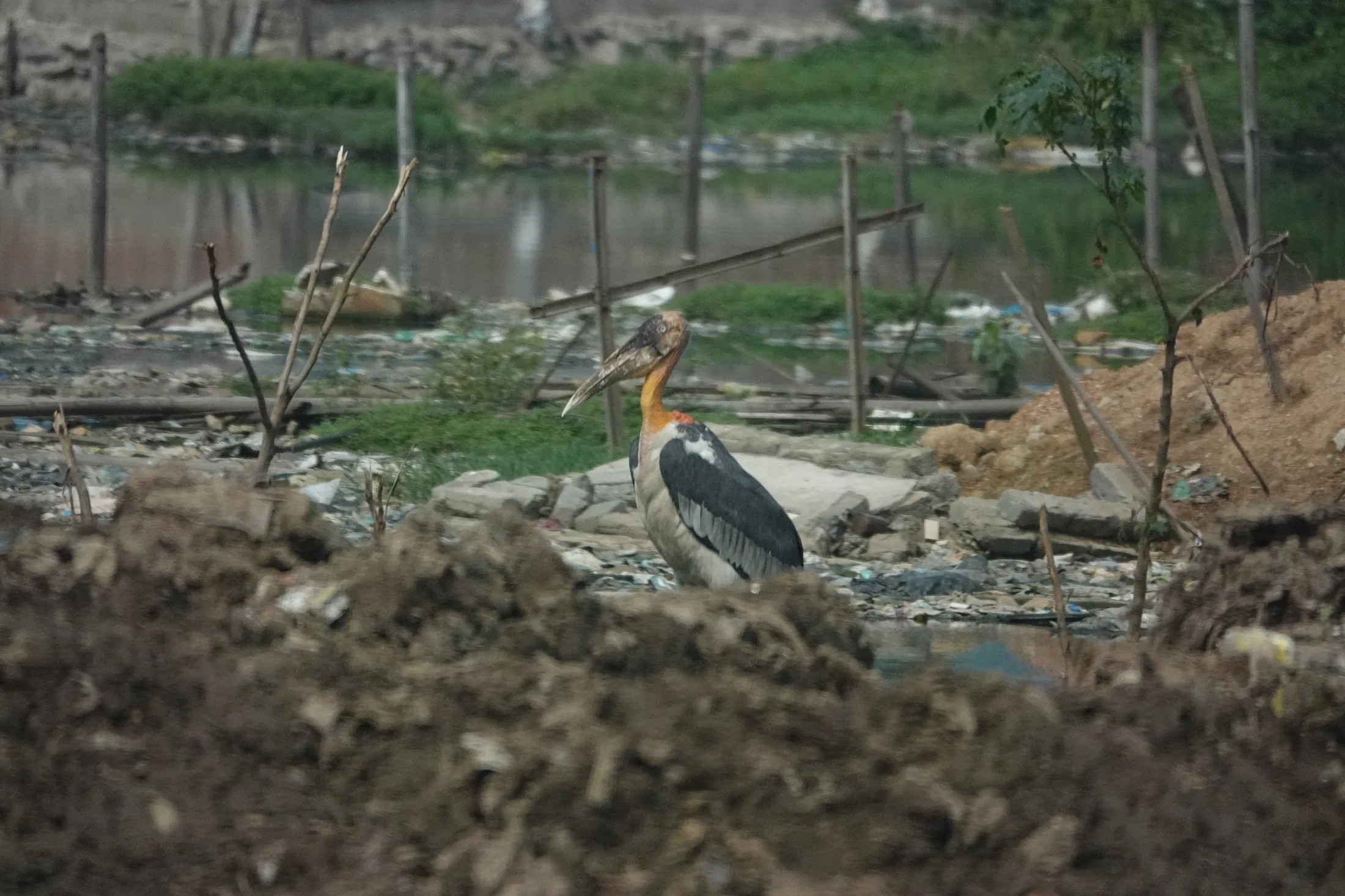
After lunch Prasanna took me for a real birding treat, one of the most famous birding sites in the world…the Guwahati dump. It’s famous because an extremely large percentage of the greater adjutants (pictured) in the world, (a very rare bird), live at this dump. There are something like 1500 greater adjutants in the world and about 40% live at this dump. I wasn’t disappointed. We went to the backside of the dump and got great views of the greater adjutants, a truly iconic but somewhat strange looking bird. We also saw striated grassbird, red-wattled lapwing and citrine wagtail just to show that we weren’t a one trick pony.
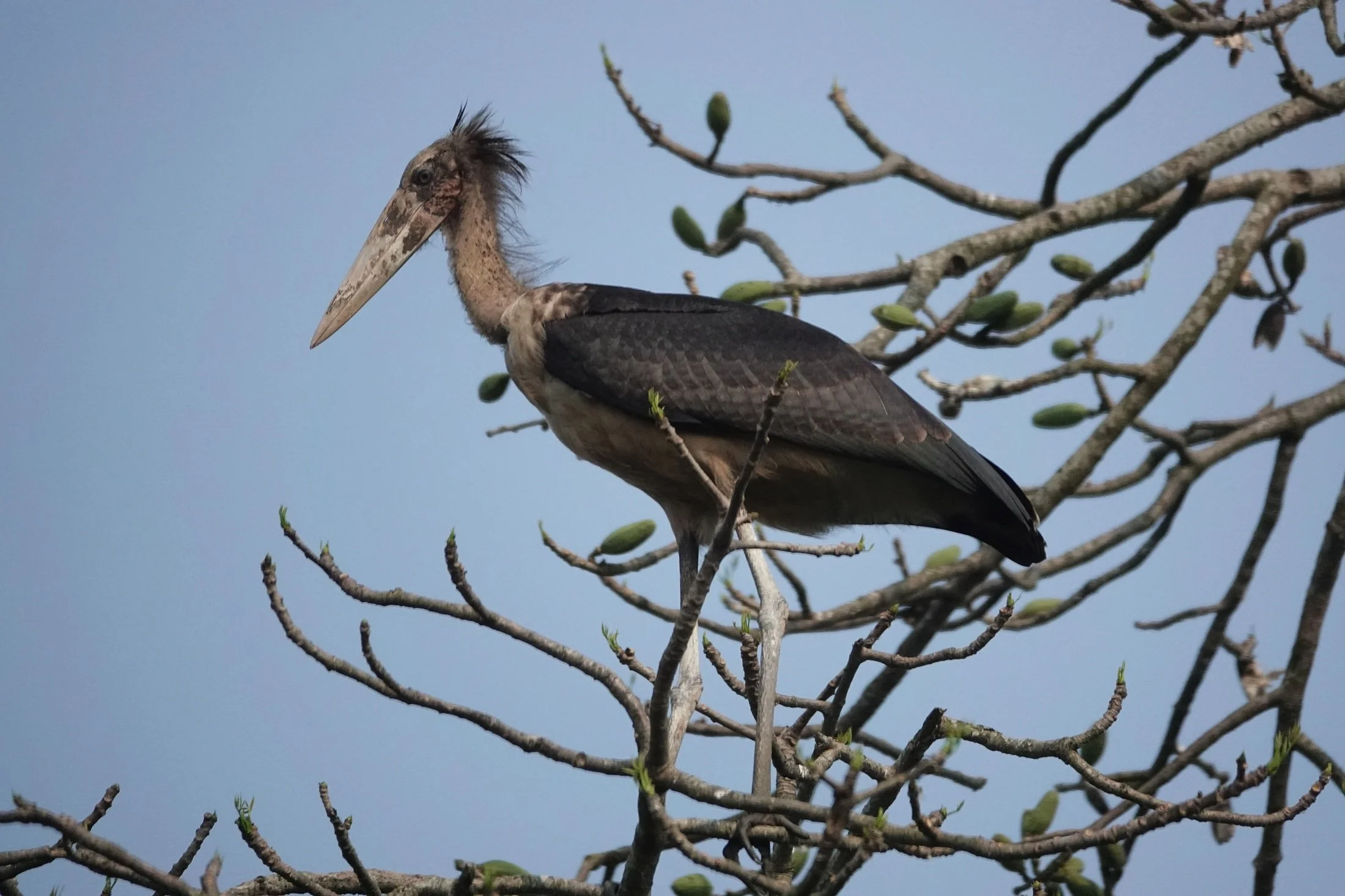
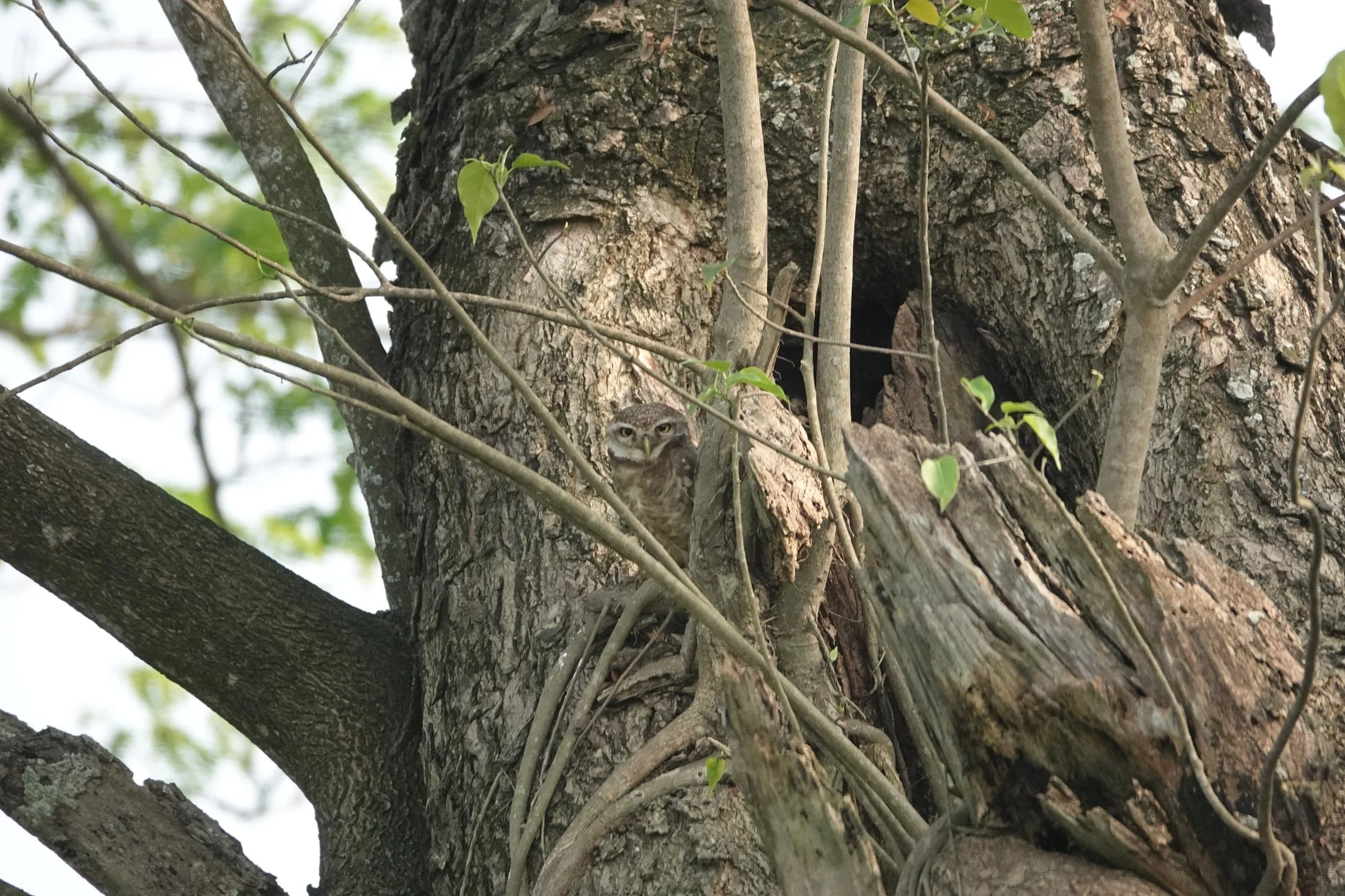
From the dump we went to Deepor Beel, a classic wetlands, in Guwahati. One bird I wanted to see we saw early and often, the cotton pygmy-goose. Other highlights were lesser whistling duck, ferruginous duck, pheasant tailed jacana, Asian openbill, oriental darter, little cormorant, Indian pond-heron, stunningly beautiful chestnut munia, paddyfield pipit, rosy pipit and a pleasant surprise, several lesser adjutant (pictured). The day ended with me finding the spotted owlet (pictured, can you see it?), in the tree it nests in. What an unbelievable day of birding. Prasanna is a spectacular birder and guide. He worked so hard to get me on birds and that’s saying something because sometimes I can be the remedial birder in class. And having Bukey along for the ride was an added bonus. He put me on several birds throughout the day as well. He’ll be great over the next few weeks. On to Eaglenest!
117 species, 87 lifers
Eaglenest
Transition Day
April 4, 2026
This morning I met Forrest in the elevator and the rest of the Eaglenest crew at breakfast. It became apparent very early that all of the people on this tour are very serious birders. And it’s wonderful.
After breakfast we went to the Guwahati dump because if you’re a birder and you’re in Guwahati that’s what you do. It was a rerun for me but we saw quite a few birds I didn’t see yesterday. Other than the greater adjutants that all birders go to the dump to see highlight birds included bronze-winged jacana, brown shrike, jungle myna and chestnut munia.
We then hit the road in three vehicles. I was in the middle vehicle with Jarmo and Jonathan. Both of then have birded their entire lives. Jarmo is from Finland and Jonathan is from Australia. We had a long drive to where we are spending the night and we had a grand old time of it talking birds and places to birds. Both of these guys have birded extensively around the world and were more than happy to answer Evan’s fourth grader question in an excited to talk about it way. Wow, so refreshing.
We stopped for a potty break and then we stopped at a lake. All of the people on this tour were so into looking for birds and finding birds and sharing what they found about birds that we saw and birds that they were reminded of. It’s all a bit overwhelming to me and I am so over my head. I absolutely love it. I’m reminded of the modern English grammar Mr. Chapman taught at Flathead High. I was the only sophomore in the class with a group of seniors. All the seniors knew so much more than me about grammar. But I plugged away at it and by the end of the semester I knew more than anyone in the class. I doubt that I will ever know as much as some of these incredible birders but I will continue to ask my fourth grader questions and absorb it all like a sponge. Highlight birds at the lake included Indian spot-billed duck and Asian palm swift.
When we got to the camp where we’re staying in rustic rooms we birded the road by the camp before supper. Lots of birds and lots more learning on my part. Some of the questions I asked were so simplistic that it brought smiles from the other birders. I don’t care. Embarrassin
g myself is the one way I will learn. Highlight birds included pin-tailed green-pigeon, Asian barred owlet that we got fabulous views of, an Oriental pied-hornbill flyover, a gorgeous rufous woodpecker, Alexandrine parakeet, ashy drongo, hair-crested drongo, verditer flycatcher and taiga flycatcher.
After supper, rice and curried chicken, (what I’ve eaten twice a day since I’ve been here), we went in search of Oriental scops-owl and brown boobook. We heard three brown boobook respond to Forrest’s playback but none came to us. But at least one and maybe two scops-owls came to us and quietly hooted in the tree above us. Forrest go a light on it and we all got great views. Definitely my bird of the day.
One of the guys commented that he thought most birders were a little out on the spectrum. I was surprised to hear someone actually say what I’ve always thought. I think it’s one of the reasons I find it so easy to relate to other birds.
84 species, 19 lifers
Rollin’ on the River
April 5, 2026
This morning started with a meagre breakfast of white bread with ghee and jam and small sweet bananas. The morning quickly improved as we saw a greater flameback in the yard of the camp we were in.
We loaded up and went the very short distance to Nameri National Park. As we waited for the permitting process to happen we birded and seeing two roufous treepie, (a bird I really wanted to see), was a highlight.
Once we got the permits all set we went with an armed park ranger to the canoe to go across the river. (Seeing elephant dung and wild big cat tracks helps to make you understand why the ranger was armed.)
Once across the river the birds came on pretty fast. A white-browed wagtail was spotted on the river shore. Bengal bushlark, Indochinese roller and a sand lark were some of the highlights.
As we entered the forest we had to be on the watch for leeches. There were lots of them. They look much like earthworms and when they latch onto you it just leaves a little mark where they suck your blood. I know, I had two such marks even though I had my socks pulled up over my pants.
Coming and going to the white-winged duck locale we saw many great birds. They included gorgeous views of pale-headed woodpeckers flying back and forth across the road. Ultramarine flycatcher, blue-capped rock-thrush, black-throated sunbird, red-whiskered bulbul, brownish-flanked bush-warbler, chestnut-bellied rock-thrush and ashy drongo were some of the highlight birds we saw before we headed for our homestay.
And then a major delay happened. One of our vehicles had a little mishap. Thankfully no one was hurt and the vehicle was unharmed but it caused a delay of nearly an hour. We sat in our vehicle and waited and waited and waited.
Finally, we restarted the journey. By this time I had a slight headache. I was tired. I was hungry. And overall I was a little grumpy.
Then a miracle happened…supper at Mon’s Homestay.
In India a homestay is basically a hostel. Mon’s Homestay is very comfortable with nice rooms and although the beds and pillows are rock hard it’s a very nice place to stay.
And supper? We’ve eaten a lot of curry and rice on this trip, basically twice a day. But the curry and the rice at Mon’s and all the fixin’s were delicious. It’s amazing what a good meal can do for the morale. We were all happy campers after. We went to bed very early because the next day was going to have a very early start.
105 species, 36 lifers
Birding by the Sky
April 6, 2026
We headed out of the homestay at 3:30 AM this morning. We were headed to Sela Pass. I slept most of the way and had my stocking cap pulled over my eyes. Unlike the high altitudes in Ecuador where the roads are wide the roads to Sela Pass were extremely narrow and there were steep drop offs. There were loads and loads of switchbacks. We ate breakfast at our first birding stop of the day. Boiled eggs, toast and bananas. Fuel for the journey. Some of the highlight birds at that stop were snow pigeon, southern nutcracker, rufous-vented tit, black-faced laughing thrush; an old friend that surprised me, goldcrest; golden bush-robin, Blanford’s rosefinch (a lifer for Forrest), and fire-tailed sunbird.
After breakfast the steep climb continued. It was a bright, cold, blue sky day with gusty winds. I had on many layers but I could have used a few more. My Etsy mittens really kept my hands warm. I was constantly blowing into them to keep the mittens and my fingers warmed. Gray-chinned minivet, alpine accentor, rufous-breasted accentor, upland buzzard, Himalayan bluetail, Blyth’s swift were among the birds we saw. But we didn’t see any of our target species.
We drove a long ways towards our homestay for lunch, (curried chicken and rice of course). The decision was made to go back to the homestay and then bird part of Dirang Morshing Road. At the homestay we discovered oriental turtle-dove and Tickell’s thrush.
Dirang Morshing Road was loads of fun to bird with nearly nonstop bird activity. Short-billed minivet, fire-capped tit, green-backed tit, gray-hooded warbler, white-tailed nuthatch, the rare for the area brown-breasted flycatcher, ultramarine flycatcher, gray bushchat, brown bullfinch and little bunting were some of the many birds we saw on this delightful afternoon.
We had dinner after the checklist review, (a daily ritual on bird tours). Then we hit the hay early because we were going to give Sela Pass another go the next day.
77 species, 50 lifers
Blood Pheasants and Snow Partridges
April 7, 2026
It was another early start this morning at 3:15. I was in Forrest’s car and Terence was in the car too. We chatted the whole way up to the breakfast spot. I had my head down the whole way. I had him look at my birding calendar and he said it was solid. He also said he was transitioning out of Rockjumper to another company. I’ll miss Forrest because he’s a really great, positive guy. The 45 minutes to the breakfast spot flew by.
The trip up to Sela Pass was another white knuckler for me. Along the way the search continued for the special birds. In more than one instance I stayed close to the car as the others went in search because the heights were really high. The weather was variable all day. Clouds, sun, and a horseshit blizzard all thrown in. And based on a tip from some other birders we finally found one of the special species, snow partridges. We saw two. Ted put them in his scope and we got great views.
We eventually made it to Sella Pass and continued search for the other special birds. Forrest flushed one of them, a solitary snipe. We all got great views of it as it sat on a flat rock.
We then searched and searched for one more bird. Forrest and Rob got views of one of them. And eventually, after several more stops we found them. Blood pheasants!!! We got incredible views of two males and a female. Definitely the bird of the day and maybe the bird of the trip. Such a stunningly gorgeous bird.
Lunch was a real treat. Momo and chop suey. I bought chocolate bars for everyone. Twenty bars in total, 200 rupees, about two dollars. (Last of the big-time Sspenders.)
We went back to Sela Pass and searched in vein and in a horseshit blizzard for grandala. It was a really snowy time and the birds were very quiet. As we worked our way down from the pass we stopped several times. Most of the stops I participated and I was sure glad I did. Some of the birds we encountered included yellow-billed blue magpie, russet bush warbler, buff-barred warbler, lemon-rumped warbler, Tickell’s leaf warbler, Himalayan beautiful rosefinch and Himalayan white-browed rosefinch.
It was good to get back to our homestay after a very long day of birding. One of many, I’m sure, on this fantastic birding adventure in NE India.
44 species, 16 lifers
On the Road
April 8, 2026
What a day. We basically birded up and down Mandala-Phudung Road all day long. We just got done doing the checklist and when Forrest asked us for bird of the day it was a tough choice because we saw so many incredible birds. The beautiful long-tailed minivet. The colorful Whistler’s warbler. The equally colorful fire-tailed myzornis that we had to search a lot for and Bukhey found it for us right after lunch. Brown parrotbill were a handsome addition to our list. Rufous-winged fulvetta, beautiful sibia, gold-naped finch were all delightful. Mrs. Gould’s sunbird is so brightly colorful. And how about a pair of gray-headed bullfinch and a pair of red-headed bullfinch in the same tree? We were highly entertained by a chestnut-crowned laughingthrush that was literally in a tree less than ten feet from us. When we saw the pygmy cupwing, (a bird I really wanted to see), Jonathon and I said at the same time, “How cute.” There is no other way to describe this little cutie.
Lunch was at a most interesting place. We all sat in plastic chairs around a wood fired stove that Rob fed wood into. We basically at in our laps. The food was spectacular, all vegetarian.
It was another long day today but we finished it off right by seeing a black-tailed crake, (the first crake I’ve ever seen), a very skulky bird that stays well hidden most of the time.
It’s bed time because another early start awaits us tomorrow.
50 species, 29 lifers
Up Into the Clouds, Twice
April 9, 2026
Another early start this morning, 3:45. We went back to Mandala-Phudung Road. We stopped for breakfast at the place we ate lunch yesterday. Breakfast was boiled eggs and toast, what we’ve almost gotten used to I guess. And it was snowing when we got there.
The birds really came fast when we started birding. Darjeeling woodpecker, red-tailed minia, rusty-flanked treecreeper, Himalyan thrush were part of the trove of birds we saw. We went down a trail with Bukhey because he had found a Temminck’s tragopan. We waited and waited as he called it in. It got close enough that Ted saw it but then it skedaddled. Oh well, it was quite the experience. But the bird of this session and maybe the day was the collared grosbeak. We saw ten of them. They are pretty infrequently seen in that location.
From Mandala-Phudung Road we birded as we left the road and there was actually a hot spot for where we birded, Domkho. Highlight birds included black-chinned yuhina, Bhutan laughingthrush, and spectacular slender-billed scimitar-babbler.
We had lunch in Rupa. Another wonderful hole-in-the-wall place. We had a tasty soup and wonderful beef momo. Then we went to the river and found several birds. The two highlight birds were a long-billed plover, (one look at this bird and you understand why it’s called long billed, quite the snoz on this one), and brown dipper, a bird I really wanted to see.
After lunch and birding we got some supplies and headed towards Eaglenest. We birded along the way and the highlight birds were yellow-rumped honeyguide with its fluffy looking feathers and a Himalayan cuckoo well spotted by Ted. We drove and walked through fog and mist several times on our journey upward.
When we got to Lama camp we checked in. Then I was heading to supper when Forrest yelled out, “Evan, turn around.” I did just that and was rewarded with incredible views of a gray nightjar, sitting on a pole not 30 feet from me.
The reason this camp is called the Lama camp is that when the Dalai Lama was fleeing Tibet after the communist takeover he stayed here one night. How cool is that?
Supper was all vegetarian and it was super yummy.
82 species, 14 lifers.
Bugun Liocichla
April 10, 2026
This morning we had the luxury of sleeping in. We didn’t meet until 5:15 AM. We only birded a very section of the road down from Eaglenest Lama Camp. We were looking for one special bird but we found many special birds as well. Some of the birds we saw included a crested goshawk displaying its white puffiness in flight, golden-throated barbet, crimson-naped woodpecker, bay woodpecker, black-headed shrike-babbler, white-browed shrike-babbler; the very showy yellow-bellied fairy-fantail; gray-cheeked warbler and greenish warbler that were in a very large flock of warblers feeding on a small bush, (must have been a bug hatch), and the wonderfully cute pygmy flycatcher.
But there was really only one star of this show that we were looking for. It flew with the rusty-fronted barwings. So all day long we looked for flocks of barwings. We found one flock early on and as I looked at in the area of the flock I saw a bird below the flock come flying across flashing red in its wings. I didn’t say anything for a couple of reasons. First, I didn’t believe my eyes. And second I’m more than just a little intimidated by the super birders I am birding with. And I mean that in a very complimentary way. All the guys on this trip, on top of being super birders are also really great guys to hang out with. That said, the bird I saw was the bugun liocichila.
Fortunately we got other views of the bird as we followed barwing flocks. The bugun liocichila is a super rare bird. There are only 16 known mating pairs of them in the whole world and all of them are in this tiny space that we birded today. Wow, wow and wow.
After checklist checking and supper we went owling and got absolutely incredible views of mountain scops-owl. Again tonight I didn’t bring my camera. Over the past two days I haven’t been as conscientious about bringing my camera as I should and I know I’ve missed out on some great photo opportunities. Note to self, bring camera every time.
Now it’s time to sleep. Last night I slept in my clothes with a pair of mittens and three very heavy blankets because it was so cold. More of the same tonight.
70 species, 29 lifers
At long last we are back to the world of the internet and I will post my field notes from the past few days. They have been very intense days but the birding has been unbelievable. I will provide hyperlinks and the like and a few pictures when I get back to London.
Eaglenest Pass
April 11, 2026
Today we left behind Lama camp. Of all the places we will stay on this trip I have a feeling it will be my favorite because of the cool story about why it’s called Lama camp. The food the whole time has been excellent. Primarily vegetarian though one night we had boiled fish to celebrate the birth of the child of one of our drivers.
We began the birding today with yet another chase of the bugun liocichila. We saw three in flight as well as many other cool birds even though we birded that stretch of road all day yesterday.
After that birding session we came back to Lama camp and had breakfast. There were egg omlettes and slices of cheese. I made an egg and cheese sandwich. It was awesome. Then we headed towards Eaglenest Pass. What a bumpy, bone jarring trip. We stopped several times to bird and saw many very cool birds. After lunch it began raining and it was a pretty steady rain. That coupled with some wind slowed the birding down to virtually nothing. Towards the end of the day we did see some really cool birds in the middle of the road. And we found a super cool little owl just before getting to camp.
Bampu camp is where we are staying. We are all staying in tents. There is no running water. To flush the toilets you pour water in the toilet until it flushes. The food, like in Lama camp, is very simple but very yummy. They served a mushroom soup that was incredible.
I haven’t said much about birds because there is no internet in this camp so Forrest couldn’t send out e-bird checklists. Oh well. When I get to a place where there is internet I’ll get all the lists and update the listings for birding out of Bampu camp.
Some of the highlight birds from today included mountain imperial-pigieon, rufous-bellied woodpecker, (absolutely gorgeous), mountain bulbul, Hodgson’s treecreeper, white-tailed robin, (in the middle of the road very late in the day), and rufous-gorgeted flycatcher, and an old but beautiful friend, Mrs. Gould’s sunbird.
Species 65, lifers 11
Spotted Elachura
April 12, 2026
What a difference a day makes. The weather today was very mild with no rain.
We had a very early start, on the road by 3:30 AM. I was in the car with Forrest and Ted. It’s always interesting to get both of their perspectives. Forrest is of the opinion that the places in Mexico that Rockjumper does tours is totally safe. I really want to go to Mexico to bird because is a long list of potential lifers there. So I’ll have to re-evaluate things and maybe replace another trip with Mexico.
I dropped Crystal at Rockjumper a line to sign me up for the Kenya Mega in 2027 because I don’t think this year’s is happening. I will have to do some shuffling but I think I can make it work. I may be doing part of Brazil this year.
Meanwhile back to the birding. We birded a section of bamboo forest and found many birds that are only located in the bamboo. We then birded all the way up to nearly camp stopping for many very cool birds. Because of no internet I don’t know exactly which birds because there were so many and it’s really dizzying to try to remember them all. That said, there was one very special bird today.
Ebird allows all birders to do all sorts of crazy things. (Can you say 7000 lifers by 70?) Ted had a really cool goal. He wants to see at least one bird in each bird family in the world. He came on this tour to see spotted elachura. Spotted elachura reminds me of pitta as far as their coloring and spotting but they are about the size of a house sparrow. Their song is an ethereal number that really sticks with you.
We have searched for this bird many times and heard it many times. But we haven’t seen it. It’s a real skulker. Today we tried several times without success to get a look at one but without success. Then this afternoon Forrest was calling it and calling it. As it came closer Rob called out “Ted, come here.” He had found the bird and Ted got a good look at it. Ted was visibly emotional after he saw the bird and he gave Rob a hug. I was so happy for Ted. I am not surprised that Rob found the bird. He’s been birding since he was about seven. Now he’s in his early 40s. He’s phenomenal at finding birds.
At one of the last stops of the day we got great views of a hornbill as nine other hornbills flew over. And there were also passing views of a woodpecker as well. I will add more commentary on birds when there is internet.
On a personal note my wordle streak will end today because I don’t have internet. My goal was to get to 100 days and I was well beyond that with Irina’s help. Oh well. I think I’d rather be birding.
And I’m slowly getting used to being in the high mountains and the steep places we have to look down. Terrence is a doctor and he said flooding therapy is something sometime used to get people over their fears. The person is exposed to the thing that they are afraid of so much that eventually they get over their fear. Perhaps being in the Himalayan foothills is my form of flooding therapy.
What a great day of birding.
The list of birds is long from this extraordinary day of birding but here are just a few highlights. Asian emerald dove, Himalayan swiftlet, changeable hawk-eagle,(the swiftllets and the hawk-eagle appeared to be hanging out together as they often do, ha, ha), rufous-necked hornbill, (what a show!!), greater yellownape, long-tailed broadbill, (what a stunner), lesser racket-tailed drongo, (what a tail), pale-billed parrotbill,(parrotbills are such cuties), beautiful nuthatch, (aptly named), and the brilliantly colored scarlet finch.
74 species, 36 lifers
Sikkim Wedge-billed Babbler
April 13, 2026
This morning we left camp at about 5:15. We had one target bird. Soon Forrest heard it and began calling it in. It kept coming and very soon it was right on top of me! Forrest told me to only move my eyeballs. We got to see a most wonderful bird, the Sikkim wedge-billed babbler up close and personal. We still have about half the trip to go but already I know it will be my number one bird of the entire trip. It has only ever been reported in this area and in Sikkim, a tiny thumb of India between Bhutan and Nepal.
We did breakfast next and then went want up the crappy road but it was cold and foggy and windy up top with very little bird activity. We came down aways and the birding picked up. But it was a tired day for most of us and a relatively quiet day of birding after all the action yesterday.
We just got back from a very fun adventure with a lesser shortwing. Forrest called it and called it and we got a very brief glance of the bird. It was doing a chattering whisper that was fun.
Tomorrow we will probably have internet so I’ll have an idea of all the birds we’ve seen. Forrest was able to get a tiny bit of internet and he said for the trip we’re over 370 species. How good is that? Plus I birded prior to the trip. Already we are nearing the number of lifers I expected from both Eaglenest and Mishmi Hills and we still have two days of Eaglenest and all of Mishmi Hills to go. What a fabulous trip for birds this has been.
All in this was a relatively quiet day for birds because of the crappy weather at the top of the road. The Sikkim wedge-billed babbler was, without a doubt, the star of the day. Large-billed leaf warbler, broad-billed warbler, Himalayan cutia, Himalayan shortwing, another cute parrotbill, the black-throated parrotbill and a surprising treat, Tibetan serin who probably shouldn’t be here at this time of year but may be because of the wet and cold weather.
62 species, 10 lifers
Long Day with a Special Ending
April 14, 2026
What a long and wonderful day of birding. We left camp at 3:30 AM and were birding at 5:00. The first bird I saw on the road was a Kalij pheasant. I’d missed it when it was in the middle of the road at other times during the trip. The we birded throughout the Eaglenest wild life sanctuary for about six hours. We turned up some truly remarkable birds including the square-tailed Durango-cuckoo, crested serpent-eagle, (We later in the trip saw two soaring over the last camp we stayed at in Eaglenest.), we saw a group of Asian house-martins circling and weaving high in the sky, there were loads of Nepal fulvetta with their huge eyerings, and flocks of birds that flew through with so many birds it is hard to imagine all of them.
We went to camp and got settled in our tents. No running water as was the case at the last camp. But even as we drank tea we saw extraordinary birds including the aforementioned crested serpent-eagles soaring and the gorgeous Asian fairy-bluebird.
I even got in a short nap before we headed back up the hill. We birded till dusk and during that time we saw some cool birds lesser necklaced laughingtrush and more wonderful Nepal fulvetta. But the star of the show was yet to come. Just after dusk Bukey started calling and soon got responses. In the dark the bird flew over us several times until at long last it landed in a tree. Forrest put a spotlight on it and voila, there was a Hodson’s frogmouth. A tiny frogmouth but oh so cute. What a great way to end a spectacular 16 hour day of birding.
Something is wrong with my camera so I didn’t get pictures. I will fiddle with the camera and see if I can get it to work.
We all have runny noses and sneeze some. According to Forrest that’s just par for the course for every tour. It happened on the Ecuador tour so no great surprise.
We had supper late and it was Tibetan themed. Very tasty but very different from the Indian food we have been eating.
94 species, 19 lifers
Coming Out of the Mountains
April 15, 2026
Today was a transition day but we still got in some good birding. It started in the dark pre-tea with a large-tailed nightjar.
After tea we went up the road again and the birding yielded a surprisingly large number of species. These included ashy bulbul, yet another very cute parrotbill species, this time gray-headed parrotbill that came through in a huge flock that also yielded striated yuhina. I got a very brief glimpse of a rufous-vented laughingthrush. We believe there were two of them around a nest in a tree we spent significant time staking out with not much for results.
Breakfast can only be described as Tibetan breakfast burritos. They were yummy and featured stewed pinto beans.
After breakfast we headed to Guwahati. As we left camp I spotted a black-backed forktail. But the true superstars of the trip down the mountain were a Jerdon’s baza soaring at eye level and two black baza displaying as they flew through the air. Wow is all I can say.
We stopped along the way for lunch at was fundamentally a truck stop. The place was packed and the food was amazing. Beside the restaurant was a little pond filled with interesting birds including many lesser whistling duck, a white-breasted waterhen, some bronze-winged jacana and a gorgeous glossy ibis.
I was in the vehicle with Ted and Forrest and we discussed our top ten birds of this part of the trip. The discussion made the time fly by and before we knew it we were back to Guwahati.
I think a shower is in order. I talked briefly with Luda. She was worried about me because they didn’t hear from me. I will talk with Irina later. She is doing revisions.
On to Mishmi Hills!
89 species, 10 lifers
Mishmi Beginnings
April 16, 2026
Today was a transition day. But first last night. There was an enormous storm that blew through Guwahati. Huge lightning and thunder and an enormous amount of rain. Kay and Rob left us. I will miss both of them. Both are incredible birders and I learned a lot from both of them. We added Mike. Personable as can be and a really solid birder.
We actually slept in today because we went to the airport and flew to Dibrugarh. We actually saw house swifts flying over the airport. Some of the folks wanted lunch before we birded. It was probably the right choice because it was very hot and somewhat humid we we arrived in Dibrugarh. We drove about 45 minutes to Tinsukia. It’s a typical sprawling Indian city with masses of people and cars and peditaxies and of course, cows. We pulled up to this little bazaar. Little did we know it was where our hotel was.
We went through the bazaar and up three flights of stairs and through construction to arrive at a very nice looking hotel lobby. The rooms are basic but good. None had toilet paper but like in other Indian hotels we’ve stayed at there was a hose beside the toilet with a nozzle on it. They must be amused when we asked for toilet paper.
After we got settled we went for lunch. It was chicken and dahl and paneer but it was so flavorful. And the naan was out of this world good.
We started birding by picking up a local guide. He and Bukey stopped at the side of this road and we started birding. We were wondering what was going on. There were wetlands on both sides of the road and a trickle of birds. Then suddenly the dam gates opened and there were all sorts of cool birds. One cinnamon bittern and two yellow bittern flew and gave us great views. The very rare pale-capped pigeon flew over and we got such a good view that we could easily see its pale cap. And a very special bird was a brow-cheeked rail that wandered in and out of the grass about 50 yards from us twice.
After this roadside extravaganza we went to Maruribeel, a big wetlands. Watercock showed very well. And we saw a huge flock of great myna as they roosted. And old friend but still an impressive sight.
We went back to the hotel for another spectacular meal, the tandoori chicken, first of the trip was so yummy.
And now I will rinse off and try to sleep. The background noise will be horns honking. That’s a constant in big Indian cities.
57 species, 9 lifers.
Island Birding
April 17, 2026
Big shocker, it was another very early morning this morning. We headed to the Brahmaputra River. It’s a fascinating river in that it floods on an annual basis during monsoon season. It is also a braided river which means it changes its channels with each monsoon season.
We had a box breakfast prior to getting onto somewhat shaky looking boats to go across a very narrow channel of the river. When we got to the other side we did a forced march to the grasslands on the island. Why? To see three very special and specialized birds, Jerdon’s babbler, marsh babbler and swamp grass babbler. Because of the hard work of Forrest and Bukey we got good looks at all three birds. What a special morning. On the walk to the boats we also saw the diminutive and delightful small pratincole.
After we took the shaky boat ride back to the mainland from the island we hopped into the cars for a long drive. I was tired from not sleeping much the night before so I took one and maybe several naps along the way. We stopped at a restaurant for lunch and bought ice cream bars for dessert. Yum. White-rumped munia were in the parking lot when we arrived.
The place we’re staying Roing is very basic. We relaxed for about an hour after we got here. I talked with Luda and Irina then. After we went to more grasslands and saw yet another set of great birds including Chinese rubythroat, scaly-breasted munia, (I figured that one out on my own), rosy minivet, (so beautifully rosy), and the flyover of a brown-backed needleback, (what a big swift). The night was capped with views of a black-breasted parrotbill.
Now it’s bedtime. To bed, to bed you sleepy head, and don’t get up till the morning.
73 species, 16 lifers
Tragopan and Trogan
April 18, 2026
This morning we had our field breakfast with a very special guest. We all heard a bird call very, very close. Forrest thought Bukey was calling a bird but he was by the cars. Forrest rushed down the hill to great our very special breakfast guest. A Blyth’s tragopan. It was indeed having breakfast, munching on the leaves it likes to eat. We got incredible views for over half an hour. What a way to start the day.
And in reality, we didn’t start the day with that bird. That honor goes to the white-spectacled warbler. Aptly named because of its beautiful eyerings.
After breakfast we proceeded up the hill towards Mayodia Pass. As expected it was a bit of a white knuckle ride for me. But for the most part all day I did okay with the heights.
We had one other very special bird. Bukey tracked down a Ward’s trogon. What gorgeous bird. Pink and purple and blue and blue eyes. We got extended views of this beauty as well.
We ate at yet another rustic spot with good food. Mike bought four good sized packets of cookies for dessert and paid all of a dollar, twenty for them.
This was a day filled with special birds. Speckled wood-pigeon, Manipur fulvetta, (a small flock of them), Mishmi wren-babbler, (extremely range restricted), Cachar wedge-billed babbler, blue-winged laughingthrush, and two shortwing species, rusty-bellied shortwing and gould’s shortwing were among the special birds we saw today. But stars were the tragopan and the trogon. What a special day of birding.
After supper I walked around the corner to the pizza joint intending to have a slice because we are contemplating pizza for supper tomorrow to shake things up a bit. Alas they were closing in ten minutes and couldn’t do me a pie. So tomorrow we could have quite the adventure in the culinary world.
It rained some this afternoon. A precursor, perhaps, of a day or two next week when there is the potential for heavy rain.
73 species, 10 lifers
Migration Day and Two Flyovers
April 19, 2026
Yet another early start. In some ways a good thing to get away from the dump we’re staying in. (More on that in a bit) Today was a bit of a clean up day because we cleaned up on birds the day before. Throughout the morning we saw large kettles of black kites fly by in migration. In total we counted 137. It was truly amazing to watch. There were also several other raptors that came along that were hard to identify.
There were two other highlights for the day, bird wise. Forrest and Bukey worked so hard to get us on these two birds. Both were flyovers for me at very low levels so they were well seen. The birds? Purple cochoa and green cochoa. Both are incredibly hard birds to see because they love to sit in trees and eat fruit without moving much. But through calls and positioning we got views of both birds.
We ended the morning session early and went to the place we’re staying. I recommended pizza for lunch. And sure enough that’s what was waiting for us. Each of us got a personal sized pizza for lunch. That’s it…
After lunch Mike and I walked around a bit. I got some tea that turns out to be working man’s tea, not the good Assam tea. Apparently it has to say orthodox on it to be Assam tea. Learn something new every day.
I then returned to the pizza place and ordered a large peperoni and a barbeque chicken pizza. I decided to go with the cheese on top. It was real runny and sort of ruined the taste of the pizzas. And all the pizza is white here. They put ketchup on it after the fact. The pizza for lunch without the cheesy sauce was good. The bread was buttery and tasty and the highlight of the pizza.
At 3:30 PM we headed out for one more birding session. We birded lower bamboo but without much success. Most probably because of the heat of the day. We then attempted to go owling up the mountain. We were stopped by forest rangers who warned of tiger activity in the area. We decided to go up and stay close to the cars.
The problem was that one of the cars was having difficulty holding power. (I thought, where is Greg when I need him?!?) We came back to the place we’re staying but not without getting lost. Car issues have been an underlying theme of this trip.
The place were staying is, without question, the worst dump I’ve ever stayed in. Dripping pipes, peeling paint, paper thin sheets, next door neighbors you can hear because there aren’t solid walls between the rooms in some instances, there are holes up above. My room doesn’t have a fan. It only has wires where a fan should be. And when we get meals we have to beg to get enough food to feed all of us.
And the heck of it is that for $8 a night per person more we could have been staying at a nice spot literally down the street from this place about 150 feet.
All of this brings up a huge question in my mind. Does Rockjumper treat their clients like this on every trip? Before I sign up for any more trips I’m going to let them know about this experience loud and clear. And I’m going to ask to see the list of accommodations for every tour I’m contemplating doing with them. And I’m going to have a frank conversation with Forrest.
It’s a double edged sword. On the one hand we’re seeing great birds, lots of species. On the other hand we’re staying in truly terrible places. Hmm…
70 species, 5 lifers.
Old Friends and Three New Ones
April 20, 2026
This morning I woke up in a grumpy mood. The room I’m in at the dump was hot and I had no fan to even move any of the air around. So I slept miserably.
I didn’t know how I would change my mood around but it soon did. When I went to the lobby there was a thermos of brewed red tea. I think it might be one of the specialties of Assam. And there were all the people I have birded with for the past three weeks. When Edwin and I birded in Ecuador and we saw a bird we’d seen before Edwin would call it an old friend. And today we saw many wonderful old friends on the birding side. But the old friends I’m referring to in the heading of this post are Jonathan and Jarmo and Terence and Ted and and Mike and Bukey and Forrest. We’ve been through so much together and seeing them yesterday morning almost instantly lifted my spirits.
The birding was good. Lesser yellownape, yellow-bellied prinia, red-whiskered bulbul, Nepal fulvetta and amazing views of a green cochoa were among the many old friends on the birding side we saw. And we also saw three very special new friends.
As we walked down the hill mid-morning a red-headed trogon started calling and Forrest found it for us. We got great views of this gorgeous bird.
As we headed back to town raptors were flying above and one was the mythical Himalayan griffon. This is the species of bird that is the primary participant in Tibetan sky burials.
Lunch was at a very nice curry shop. The food was great. I smile as I think about that and dinner. I’m sure it was planned that way to say sorry in a small way for the dump we stayed in.
We had a break and then went to the river bottom of the Brahmaputtra. Mind you, the river bottom is about 10 miles across this time of year.
Dinner was at a nice restaurant. The problem was the service. It was beyond slow. We wound up leaving in shifts as people’s food got served to them and they ate.
Throughout this day it was the people I’ve birded with that made it so enjoyable. And at lunch Forrest told us he was taking lots of notes on how terrible the place we stayed was. And he told us who to write to at Rockjumper about this. I will definitely be doing that.
91 species, 3 lifers.
Breakfast Lifers
April 21, 2026
We left early for birding because we had a long drive ahead of us. All of us were happy to put the Roring place in the rearview mirror. As we drove the rain was pouring. It finally let up and we stopped for breakfast along the road. (Omelet with naan to scoop it with today, very tasty.) We stopped at a sort of wet patch of ground. And there were all sorts of fun birds around. Old friends like cinnamon bittern and even older friends like common snipe. But there were also two lifers, gray-headed lapwing and greater painted-snipe. Both are birds I’d never heard of before and both are really cool. What a great way to do breakfast.
We did a load of birding today and produced a lot of birds. The most frustrating was the chestnut-backed laughingtrush. This is a range restricted bird and a very shy bird. Bukey called it and called it and it came so, so close to us several times. Once a couple people saw them cross the road. But no one got a real good view of them.
A comical incident for me was when a pied falconet flew by. I saw a pigeon at the same time as everyone else watched the pied falconet. Our local guide thinks he can find this bird again tomorrow. And if not I have a chance to see it in northern Vietnam. Seeing birds and picking out flying birds is still something I have trouble with. Time in the field will help that.
But there were other birds we got great views of. The ruddy kingfisher is a stunningly beautiful bird. Late in the day we got good views of Hodgson’s hawk-cuckoo and even better views of chestnut-winged cuckoo. A gray-headed woodpecker, first of the trip, showed well. And the local guide pointed out two crow-billed drongo. Apparently, they are just coming into the area for the season. These are the first he’d seen. And my favorite bird of the day was the diminutive yellow-vented flowerpecker.
A large part of the drive to the hotel was in heavy, heavy rain. And just as we got to the hotel another heavy rain with earsplitting thunder came. We stayed at this hotel a few days ago and it seems like the Ritz after what we endured in Roring. What a very good day of birding.
104 species, 11 lifers
Waiting in the Rain
April 22, 2026
Another 3:30 start this morning on a morning that promised lots of rain. We at breakfast under the cover of the Dihing Patkai National Park ranger station awning. Red junglefowl, (the ancestor of the common chicken), and greater necklaced laughingthrush joined us for breakfast.
When the park ranger with the rifle, (for protection from elephants), came we headed out. At our first stop it was pouring rain and we walked on a muddy and at times steep path to search for the first bird. There was no need for a search. The beautiful gray peacock-pheasant was perched right where our local guide took us. We were within 15 feet of it. Truly an amazing bird.
On the hike back to the vehicles we also got passing views of a Hainan blue flycatcher. A second one was heard calling.
If we thought the trail to the first stop was steep and muddy that was nothing compared to the hike into the second spot. Steep and muddy trail in one spot and the rain was coursing down. At one point the trail was through a very shallow but running stream. When we got to the viewing area we waited and watched a hallowed out knot in a tree. And we waited and we waited and we waited. Forrest decided we’d only wait 30 more minutes. Twenty minutes later our wait was rewarded. Three brown hornbill flew toward the hole. Over the next fifteen minutes we watched two of the hornbill feed young in the hole. We also learned that these hornbills are multi-generational breeders. One female will produce a brood and then other younger members of that family will help to feed the young. First we saw an older hornbill feed the young and then a less mature bird fed them. Absolutely wonderful bird and an absolutely fascinating story.
It was a slip sliding adventure getting back to the road. On the final hill I just slid down on my butt. I cleaned my rain pants later at a scrubbing area where we ate lunch.
The rain let up some and we birded along the road until lunch. Of the many bird species we saw the most rewarding birds were stunningly beautiful Blyth’s paradise-flycatcher. A migrating ferruginous flycatcher also graced us with its presence.
We birded one more spot close to the park and were rained on some before we retreated to the vehicles. As we headed out of the spot we stopped and were rewarded with magnificent views of greater necklaced laughingthrush, an elusive bird that we’d only heard previously.
We then drove to a Maguribeel grassland and soon located two bristled grassbirds. As they flew from one grassy spot to another they were displaying. One landed on the roof of a little shack for brief but good views. Zitting cisticola, a large flock of chestnut munia, paddyfield pipit, all old friends, were also noted.
We drove a bit further and got brief views of a Byth’s reed warbler though several were heard singing. We also got good views of a shikra, a small beautiful raptor as it flew away.
Supper as again very good when we got to the hotel. The naan here is particularly good.
A very productive rainy day.
92 species, 8 lifers
Gearing Down, Birding Up
April 23, 2026
This morning we didn’t meet up until 6:30. What a wonderous miracle a good night’s sleep is. We ate a lovely breakfast at the hotel.
Then we took the five hour drive to Kaziranga. I was riding with Mike and Forrest. We recounted the many ups and downs of this trip for each other. Forrest said he and Ted were talking about the fact that this was my very first Rockjumper trip and it is one of the most difficult Rockjumper trips. I’ll believe it when I see it but it’s reassuring that so far I’ve survived this trip. The one factor that made it so enjoyable was definitely the people I birded with over the past three weeks. Every one of them is a top notch birder and every one of them is a great person on top of that.
One bird we saw on the wire was a bird narrowly missed in Norfolk, a black winged kite.
When we arrived at the place we were staying at Kaziranga we were assigned rooms. Mine is absolutely lovely. We had a wonderful lunch. Then at 2:30 PM we headed to Kaziranga National Park. We were on safari and rode in open topped safari vehicles. It’s the first time I’d ever done this and it was a real hoot. (more on hoots here in a second).
We slowly drove one of the roads in Kaziranga and saw wonderful views of elephants and rhinos and deer and other critters. I was surprised by my reaction to the mammals. I thought it was pretty cool. And of course we saw birds.
The birds seen included a whiskered tern flying over one of the wetlands, black-necked storks and one of my targets, Asian woolly-necked storks. We saw several spot-billed pelicans in the water. And we saw a slender-billed vulture perched at the top of the tree in what appeared to be a roosting position. Blossom-headed parakeet was above our heads in a tree at one point. I saw the gray headed female but will probably see the more resplendent male later in our adventure here. Eastern red rumped swallows soared over our heads at one point. And I actually found ashy prinia, another new bird for the trip.
The icing on the cake came when our guide/driver found a brown fish-owl. We got great views of it outside the park.
On the way home Bukey stopped at a tea shop so I could get some good Assam tea. I bought orthodox tea. And after I ordered it they packaged it as I waited from huge bags of loose tea. What fun.
The next two days we will continue to bird Kaziranga, going to different areas of the park and birding safari style. What a wonderful way to gear down after a very long and fruitful birding trip.
Yesterday when we saw the bristled grassbird it was my 442nd lifer for the trip. My expectation was that I would see 441lifers. So every lifer I see from here on out is just gravy on the road to 7000.
76 species, 11 lifers
Elephant Crossing
April 24, 2026
A postscript from last night. I heard a brown boobook outside my room. Mike and Jarmo also heard it. We tried calling it and eventually Jarmo got a light on it long enough for us to see it fly too another tree. A cool bird.
Today we continued the Kaziranga birding safari. We birded the east end of the park in the morning. The park opened at 7:30 and we got to the gate early. It gave us time to walk down the road and see baya weaver nests high up in the palm trees. We saw baya weavers yesterday but to see their nests was really cool. They are the first weavers I’ve ever seen. Looking at their nests you understand why they are called weavers.
Inside the park we had a really good session of birding, seeing over 100 species in the morning. Some of the highlights included two marsh sandpipers, two truly stunning black-headed ibis, several gray-headed fish-eagles and a flyby stork-billed kingfisher. Perhaps the bird star of the day was a puff-throated babbler. I even got a picture of it singing away. It is aptly named with its beautiful puffy neck.
When we turned around to return we had significant delay because a large herd of elephants decided they needed to use the road. We got incredible views as we waited and at one point a huge bull elephant looked at us and trumpeted. After about a half hour wait the elephants decided it was time to go back into the brush and we were able to get rolling again.
After another yummy lunch at the lodge we headed back to the central part of the park. (We had birded it yesterday afternoon.) It was busy as can be with traffic as safari vehicles plied the dirt roads looking for tigers.
In spite of all these goings on we did manage to see some really cool birds including a beautiful streak-throated woodpecker. And after lots of work by Bukey we saw two slender-billed babblers. Two very difficult birds to see.
Speaking of difficult to see there was a big rumor of a tiger sighting and dozens of vehicles converged on the spot of the sighting. Many people including all the people in our other vehicle saw the tiger. Ted and I did not. I was bummed at the time but with some reflection I’ve come to realize that in the whole grand scheme of things it’s really not that important.
If there is a rumored tiger sighting tomorrow I want to be on the other side of the park from it. Why? Because it’s a Saturday tomorrow and it will be bedlam beyond the insanity of today. Let’s go birding.
And today I got a bonus lifer. I saw a black-winged stilt. Two summers ago I saw one in Norfolk and Merlin classified it as exotic. Not in Assam. So it doesn’t show up as a lifer today but my lifer total went up by one more.
114 species, 8 lifers
Rain Delay
April 25, 2026
As the start time for today’s play neared it was clearly obvious there would be a rain delay. Rain was pouring from the sky in a way that has become familiar over the past three weeks. Though thankfully it has not happened often. Lightening and thunder accompanied the storm and it was actually quite dark.
By the time the covers were removed and the umpires checked the light and the captains checked the pitch, the outfield and the run ups there was a delay of about an hour before play resumed.
What a most interesting penultimate day of birding. We started birding the western part of Kaziranga NP, also known as Bagori. Some forest in this section of the park but lots of grass and water as well. And lots of up close and personal views of big mammals like rhinos and water buffalo.
The birds were plentiful as well. There were many great views of old friends like black-necked stork, black-headed ibis and spot-billed pelican. It really was a raptor kind of morning though. Indian spotted eagle was spotted by Jonathon soaring in the distance. And a family of Palla’s fish-eagles were seen at various times and places during the session.
At one point I was looking at what seemed like small birds to me, (after staring at pelicans and eagles and the like all morning). Turned out they were common woodshrike, a new bird for this trip. A good final bird for the morning session.
After lunch there was time for a power nap. Then we headed off to the central portion of Kaziranga. As we entered the park a storm blew over us and the covers literally had to be put on the safari rigs we were riding in. Two waves of rain came through. Not super heavy, more of an annoyance than anything else.
Soon enough the storm blew over. We’d done such a good job of finding birds we were able to stake out tigers for me and Ted. And we were also staking out a very special bird that hadn’t been reported for eight years. We didn’t see any tigers but we saw the special birds in flight, Finn’s weaver. A flock of six weavers we couldn’t identify flew over. Than shortly after a flock of four. One of the flock of four was bight yellow and the three brown birds seemed dark.
At one point I asked Forrest where in the world would be the very best place to see these birds. He said 135 yards down the road.
About 135 yards down the road Forrest got one more look at them and confirmed the one bright yellow bird! Bukey also got a good look and he verified that at least the one bright yellow bird was a Finn’s weaver and not a Baya weaver. As if that wasn’t enough a flock of Baya weavers flew by a little later and provided the needed contrast with the other birds we saw earlier. The females were definitely not as darkly colored.
What a wonderful bird to close out the NE India ledger. I came on this trip expecting to get 441 lifers. 514 birds were observed and a whopping 469 were lifers, far exceeding my expectations. I have to attribute a lot of that to Forrest. He’s an extraordinary birder who is passionate about birds. Throughout the trip he did everything in his power to put all of us on the great birds we found. And the guys I birded with were all super good birders and great fun to bird with and hang out with. I have learned so much from them.
And just to make that point, Jonathon and Forrest had fun with me today. They had me identify bee-eaters. I did and I don’t think I’ll forget them. Over the past three weeks I’ve slowly become familiar with NE Indian birds.
94 species, 4 lifers
For the trip:
514 species, 469 lifers